
July 11, 2026
Application of Biaxial Stretched Plastic Geogrid in Railway Subgrade Reinforcement: Performance Advantages of High Tensile Strength and Low Elongation Based on Beijing-Zhangjiakou High-Speed Railway Case
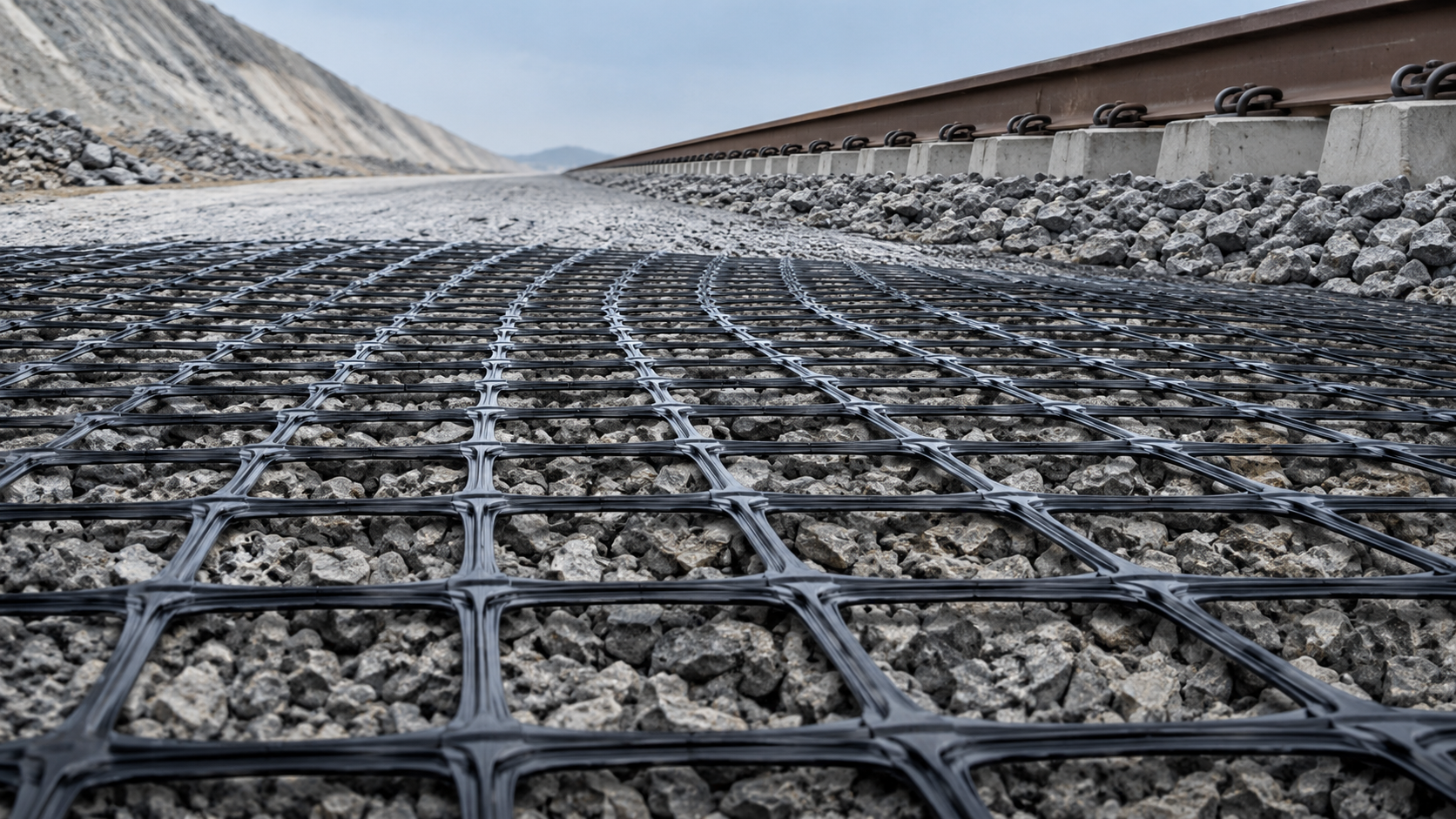
Table of Contents
1. Overview of Railway Subgrade Reinforcement Technology
2. Structural Characteristics of Biaxial Stretched Geogrid
3. Core Subgrade Reinforcement Performance of Geogrid
4. Engineering Performance Data Comparison
5. Practical Application in Beijing-Zhangjiakou High-Speed Railway
6. Construction Application Guidelines for Railway Projects
7. Industry Technical FAQ
1. Overview of Railway Subgrade Reinforcement Technology
High-speed railway subgrade requires extreme stability and deformation resistance. Long-term dynamic load will cause settlement and cracking of ordinary roadbeds.
Traditional stone and cement reinforcement methods are high-cost and short service life. It cannot adapt to long-term high-frequency vibration of high-speed rails.
Biaxial stretched geogrid has become a mainstream material for railway subgrade reinforcement. It delivers excellent tensile and anti-deformation performance.
In recent years, geogrid application in high-speed rail infrastructure has grown rapidly. Many trunk railway projects adopt this reinforcement solution.
According to 2025 international railway infrastructure data, qualified geogrid reinforcement can reduce subgrade settlement by 62% and extend road service life by more than 30 years.
2. Structural Characteristics of Biaxial Stretched Geogrid
2.1 Biaxial Stretching Manufacturing Principle
Biaxial stretched plastic geogrid is produced through one-time integral biaxial stretching process.
The grid structure forms uniform force-bearing nodes in both horizontal and vertical directions. No weak connection points exist.
This integrated structure effectively disperses soil pressure. It is more stable than woven and welded geogrids.
2.2 Basic Material Advantages
The raw material is high-density polyethylene plastic, with strong anti-aging and anti-corrosion ability.
It can maintain stable physical performance in humid, frozen and saline soil environments.
This feature makes it very suitable for complex geological railway subgrade reinforcement projects.
3. Core Subgrade Reinforcement Performance of Geogrid
3.1 High Tensile Strength Performance
Railway subgrade bears huge repeated dynamic impact force. High tensile strength is the core index of reinforcement materials.
Qualified biaxial geogrid provides balanced bidirectional tensile force. It restricts lateral displacement of subgrade soil.
It effectively avoids subgrade expansion, collapse and uneven settlement under train load.
3.2 Low Elongation Rate Advantage
Many ordinary reinforcement materials deform easily under long-term load. Even small stretching will cause rail surface unevenness.
Biaxial stretched geogrid maintains ultra-low elongation under rated load. It ensures long-term flatness of high-speed rail subgrade.
Low deformation performance is the key to guarantee high-speed railway operation safety and comfort.
4. Engineering Performance Data Comparison
The table below compares the subgrade reinforcement performance of traditional materials and biaxial stretched geogrid, based on UIC international railway engineering standards.
Reinforcement Material | Bidirectional Tensile Strength | Load Elongation Rate | Long-Term Settlement Volume | Service Life |
Traditional Gravel Reinforcement | Unbalanced, Discrete Force | 12.5% | 18–24mm/10 years | 15–20 Years |
Ordinary Woven Geogrid | 30–40kN/m | 8.2% | 10–13mm/10 years | 25–30 Years |
Biaxial Stretched Plastic Geogrid | 50–80kN/m | ≤3.0% | 3–5mm/10 years | 50+ Years |
Test data shows that biaxial geogrid has overwhelming advantages in tensile stability and anti-deformation ability. It fully meets strict high-speed rail construction standards.
5. Practical Application in Beijing-Zhangjiakou High-Speed Railway
The Beijing-Zhangjiakou High-Speed Railway is a landmark high-speed rail project with complex terrain and strict construction standards.
A large section of the line passes through soft soil and seasonal frozen soil areas. Subgrade stability faced huge challenges.
The project adopted biaxial stretched geogrid for full-section subgrade reinforcement. It solved the problem of easy settlement of soft soil foundation.
After years of operation detection, the reinforced subgrade has no obvious deformation. The track flatness index remains excellent.
This project fully verifies the reliable subgrade reinforcement performance of biaxial geogrid in high-standard railway engineering.
6. Construction Application Guidelines for Railway Projects
Lay biaxial geogrid flat during construction, avoid folding and excessive tension.
Ensure grid lap joint length meets railway standard, prevent stress concentration at joints.
Match different tensile specifications according to subgrade load and geological conditions.
Strictly control covering soil thickness to avoid grid damage during rolling construction.
7. Industry Technical FAQ
Q1: Why biaxial stretched geogrid is preferred for high-speed railway subgrade?
A1: It has balanced bidirectional high tensile strength and ultra-low elongation rate. It can effectively control subgrade deformation and ensure long-term stable operation of high-speed rails.
Q2: What core problems does geogrid application solve in railway engineering?
A2: It solves common problems such as subgrade settlement, lateral sliding, cracking and uneven deformation caused by geological and load factors.
Q3: What is the advantage compared with traditional subgrade reinforcement methods?
A3: It has lower elongation, longer service life, stronger corrosion resistance and more uniform force dispersion, with lower long-term maintenance cost.
Q4: Is the Beijing-Zhangjiakou High-Speed Railway geogrid application effective?
A4: Very effective. Long-term operation monitoring shows that the reinforced subgrade has stable indicators, no settlement disease, meeting high-speed rail safe operation standards.