
August 11, 2026
Biaxial Plastic Geogrid Roadbed Reinforcement Mechanism: Design and Construction Specification Analysis for Soft Soil Subgrade Stabilization
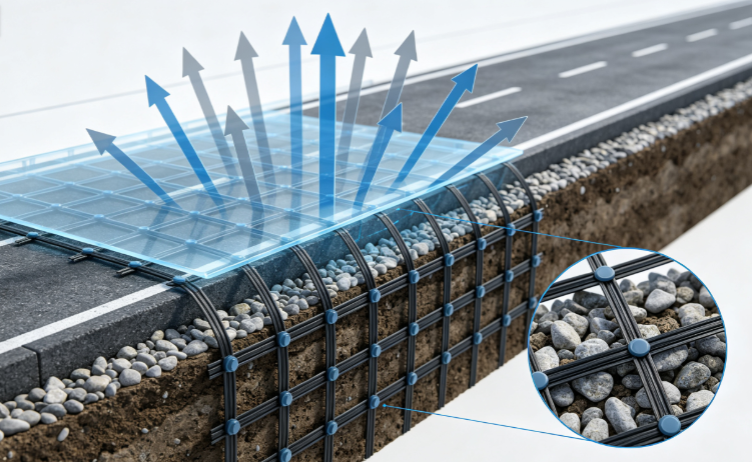
Table of Contents
1. Introduction to Biaxial Plastic Geogrid for Roadbed Reinforcement
2. Core Reinforcement Mechanism of Biaxial Geogrid in Soft Soil Stabilization
3. Standard Roadbed Design Rules for Soft Soil Subgrade Reinforcement
4. Standard Construction Practices for Biaxial Geogrid Installation
5. Performance Data Comparison: Reinforced vs Unreinforced Soft Soil Roadbed
6. Common Construction Issues and Practical Fixes
7. Industry FAQ
1. Introduction to Biaxial Plastic Geogrid for Roadbed Reinforcement
Soft soil subgrade is a common challenge in road construction. It has low bearing capacity and high compression deformation.
Long-term heavy vehicle loads easily cause uneven settlement and pavement rutting on soft soil foundations.
Traditional soft soil treatment methods like soil replacement and preloading cost more time and money. These methods also fail to stop long-term secondary deformation of roadbeds.
Biaxial plastic geogrid is a key geosynthetic material for modern roadbed reinforcement and soft soil stabilization.
It is manufactured with polymer extrusion, punching and bidirectional stretching processes. It delivers balanced tensile strength in both longitudinal and transverse directions.
This material fits most highway and municipal road projects. It works well for standard soft soil加筋 and foundation upgrade works.
2. Core Reinforcement Mechanism of Biaxial Geogrid in Soft Soil Stabilization
2.1 Soil and Aggregate Interlock Effect
Biaxial geogrid has regular and uniform mesh apertures. The grid locks loose aggregate and soft soil particles tightly.
This interlock limits lateral soil movement under dynamic traffic loads. It forms a rigid composite roadbed structure.
2.2 Vertical Load Dispersion
Soft soil has almost no tensile resistance. Concentrated wheel loads easily deform the subgrade.
Biaxial geogrid bears tensile stress from subgrade deformation. It spreads local vertical loads to a wider soil area.
This effect cuts down vertical pressure on soft layers and controls roadbed settlement effectively.
2.3 Overall Subgrade Stability Improvement
Multi-layer geogrid laying connects loose fill and weak foundation soil. It raises the overall stiffness of the roadbed.
It reduces differential settlement and extends the service life of paved roads.
3. Standard Roadbed Design Rules for Soft Soil Subgrade Reinforcement
All roadbed design solutions must match site soil conditions and traffic load levels. CBR value is the core index for material selection.
Below is the standard material matching table for different soft soil CBR conditions, following FHWA and AASHTO design guidelines.
Soft Soil CBR Value | Recommended Biaxial Geogrid | Minimum Junction Efficiency | Design ESAL Load Limit | Matching Aggregate Size |
1% - 3% | TGSG30-30 / TGSG40-40 | >93% | 1.5 million | 1.5″ - 2.5″ |
<1% | TGSG45-45 / TGSG50-50 | ≥95% | >3 million | 2.0″ - 3.0″ |
Key design limits control the final reinforcement effect. General roadbed tensile strain is limited below 6%.
Shallow embankments under 0.7m height need a 3% strain limit to avoid grid fatigue damage.
Standard layer spacing for multi-layer laying is 0.3m to 0.6m. It must be 5 times larger than grid aperture size.
4. Standard Construction Practices for Biaxial Geogrid Installation
4.1 Base Surface Preparation
Clean all debris, roots and raised soil on the soft subgrade surface.
Level and pre-compact the base to create a flat and uniform working surface.
4.2 Geogrid Laying and Fixing
Lay biaxial geogrid flat and tight. Do not leave folds or twists during installation.
Keep 10cm to 20cm overlap between adjacent grids. Fix edges with soil nails every 1.5 meters.
4.3 Filling and Compaction
Spread aggregate from the middle to both sides. This prevents grid displacement.
Use layered compaction. Choose light rollers for initial pressing to protect grid nodes.
4.4 Layer Inspection
Check flatness, overlap width and node integrity after each construction step.
Repair all unqualified parts before next filling work.
5. Performance Data Comparison: Reinforced vs Unreinforced Soft Soil Roadbed
Field test data shows obvious performance improvement after biaxial geogrid soft soil加筋 treatment.
Performance Index | Unreinforced Roadbed | Geogrid Reinforced Roadbed | Improvement Level |
Post-construction Settlement | 25mm - 40mm | ≤8mm | 72% - 80% reduction |
Settlement Convergence Speed | Slow | 40% faster | 40% efficiency rise |
Bearing Capacity | Low and unstable | Greatly improved | 35% - 50% increase |
Geogrid reinforcement also cuts aggregate usage by 30% to 40%. It shortens soft soil road construction cycle greatly.
6. Common Construction Issues and Practical Fixes
6.1 Grid Wrinkle and Displacement
Fast filling speed often causes grid wrinkles. It weakens soil-grid interlock performance.
Stop filling immediately. Re-stretch and fix the grid before continuing construction.
6.2 Insufficient Overlap Width
Small overlap leads to local stress concentration and partial settlement.
Keep minimum 10cm overlap for normal roads. Use 20cm overlap for heavy traffic sections.
6.3 Grid Node Damage
Over compaction pressure breaks grid nodes. The grid loses bidirectional tensile performance.
Use light roller for first compaction. Avoid sharp aggregate hitting grid nodes directly.
7. Industry FAQ
Q1: Why choose biaxial geogrid for soft soil roadbed reinforcement?
A1: It has balanced bidirectional tensile strength. It provides all-round soil confinement. It works more stable than uniaxial grids for large-area soft soil stabilization.
Q2: How many geogrid layers are needed for soft soil roadbed?
A2: 1 to 2 layers for shallow soft soil within 2m depth. 3 to 4 layers for deep soft soil over 2m depth. Keep 0.3m-0.6m layer spacing.
Q3: Can biaxial geogrid work in humid soft soil environments?
A3: Yes. Polypropylene biaxial geogrid has great water and corrosion resistance. It keeps stable performance for over 50 years in pH 2-13 soil environments.
Q4: What is the biggest advantage of geogrid roadbed construction?
A4: It saves construction time and aggregate cost. It solves long-term settlement problems that traditional soft soil treatment cannot fix.