
September 20, 2026
High-quality Geosynthetic Materials for Infrastructure and Road Construction Projects
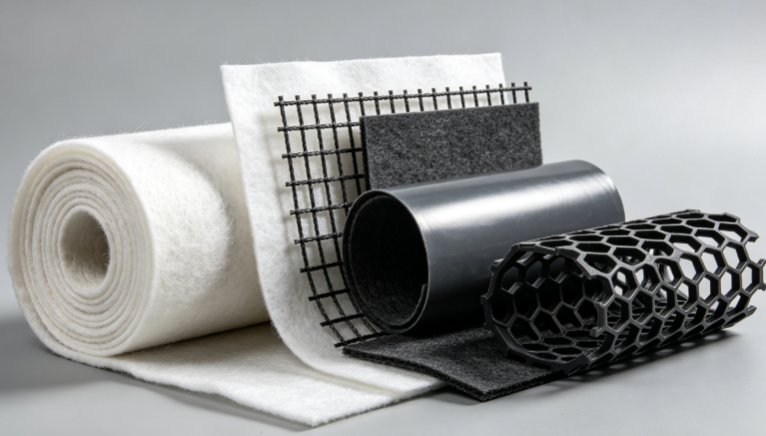
Table of Contents
1. Introduction 2. Main Types of Geosynthetic Materials 3. Key Functions of Geosynthetic Products in Engineering 4. Application Scenarios for Infrastructure & Road Projects 5. Product Performance Advantages 6. Strict Production & Quality Inspection Standards 7. Standard Construction Guidance Notes 8. Common Engineering Challenges & Solutions 9. Comparison of Typical Geosynthetic Materials 10. Why Choose Our Geosynthetic Materials 11. Conclusion 12. Industry FAQ |
1. Introduction
Road construction, municipal infrastructure, water conservancy and environmental projects put forward high requirements for foundation stabilization, anti-seepage, isolation and reinforcement. Inferior geosynthetic materials easily lead to road settlement, pavement cracking, water leakage and shortened service life of engineering structures.
We supply high-quality geosynthetic materials tailored for infrastructure and road construction projects. Our product range covers mainstream civil synthetic materials widely adopted in highway, municipal engineering, water conservancy, landfill and railway projects, providing reliable ground treatment solutions for global engineering contractors.
Market Data Reference Geosynthetic materials are essential for extending the service life of transportation infrastructure. Standardized high-performance geosynthetics effectively reduce later maintenance costs of road and foundation projects. (Geosynthetics Industry Report, 2026) |
2. Main Types of Geosynthetic Materials
2.1 Geotextiles
Non-woven geotextile, woven geotextile for separation, filtration, protection and reinforcement.
2.2 Geogrids
Plastic geogrid, fiberglass geogrid, steel plastic geogrid used for road base reinforcement.
2.3 Geomembranes
HDPE geomembrane, composite geomembrane for anti-seepage in reservoirs, landfills and ponds.
2.4 Geocomposites & Auxiliary Products
Geonet, drainage board, geocell, waterproof bentonite liner and supporting construction accessories.
3. Key Functions of Geosynthetic Products in Engineering
· Reinforcement: Improve foundation bearing capacity, reduce uneven settlement
· Isolation: Separate soil layers of different particle sizes
· Filtration: Allow water penetration while blocking soil particle loss
· Anti-seepage: Prevent liquid leakage for environmental and hydraulic projects
· Drainage: Accelerate excess water discharge inside the foundation
· Protection: Reduce erosion and avoid damage to anti-seepage structures
4. Application Scenarios for Infrastructure & Road Projects
Highway & urban road widening, railway subgrade treatment, bridge approach foundation reinforcement, municipal tunnel projects, river slope protection, reservoir anti-seepage, landfill lining, parking lot foundation treatment, coastal soft soil improvement.
5. Product Performance Advantages
· High tensile strength and strong deformation resistance
· Excellent anti-aging and anti-ultraviolet performance
· Stable chemical corrosion resistance against soil and groundwater
· Low permeability fluctuation, consistent filtration and anti-seepage performance
· Convenient cutting, transportation and on-site laying
· Meet international civil engineering material testing standards
6. Strict Production & Quality Inspection Standards
· Raw material incoming inspection of polymer particles
· Online monitoring during continuous extrusion and weaving production
· Regular sampling test for tensile strength, elongation, permeability and thickness
· Anti-aging and environmental adaptability laboratory testing
· Complete inspection reports and material certification documents available
· Stable product performance batch by batch
7. Standard Construction Guidance Notes
Clean and level the foundation surface before laying; avoid sharp objects piercing materials; reserve reasonable overlap width; implement reliable fixing measures; complete protection and backfilling in time after laying to prevent long-term direct sunlight exposure.
8. Common Engineering Challenges & Solutions
• Challenge 1: Soft foundation causes road uneven settlement
Solution: Adopt geogrid matched with geotextile for composite reinforcement.
• Challenge 2: Water seepage causes embankment instability
Solution: Use composite geomembrane for anti-seepage and set drainage layers.
• Challenge 3: Short service life under long-term outdoor exposure
Solution: Select anti-UV modified raw material products.
• Challenge 4: On-site construction damage reduces material effect
Solution: Provide professional laying technical guidance and protective suggestions.
9. Comparison of Typical Geosynthetic Materials
Index | Geotextile | Geogrid | Geomembrane | Geocell |
Core Function | Filtration, isolation, protection | Foundation reinforcement | Anti-seepage | Three-dimensional restraint, slope stabilization |
Main Application | Road base, slope protection | Highway subgrade | Landfill, reservoir | Slope greening, soft foundation |
Characteristic | High permeability | High tensile modulus | Low water permeability | Three-dimensional constraint structure |
10. Why Choose Our Geosynthetic Materials
· Complete series covering all mainstream geosynthetic products for infrastructure
· Strict raw material control and standardized production workshop
· Support customized width, thickness and technical indicators for special projects
· Rich export experience for overseas infrastructure contractors
· Supply test reports and engineering technical consultation
· Flexible packaging suitable for sea transportation and bulk delivery
11. Conclusion
Stable and high-performance geosynthetic materials are critical to guarantee long-term safety of roads and infrastructure projects. Poor-quality materials will trigger hidden engineering risks and increase maintenance costs.
We provide high-quality geosynthetic materials specially designed for infrastructure and road construction. With diversified product portfolio and stable quality, we deliver systematic ground treatment solutions for global road, municipal, water conservancy and environmental engineering projects.
12. Industry FAQ
Q1: Can you customize specifications such as width, tensile strength and thickness?
A: Yes, we support customized technical parameters according to engineering design requirements.
Q2: What certificates and test reports can be provided?
A: Third-party laboratory inspection reports, material certificates and factory quality documents are available.
Q3: Are products suitable for tropical high-temperature and coastal corrosive environments?
A: Anti-aging and anti-corrosion modified materials can be produced for special working conditions.
Q4: Can you provide construction technical guidance?
A: We supply professional laying suggestions and technical documents for engineering teams.
Q5: What is the delivery cycle for bulk orders?
A: Standard specifications have fast delivery; customized products will be arranged according to requirements.