
August 11, 2026
Application of HDPE Geomembrane in Landfill Impermeability System: A Complete Solution from Material Selection to Welding Quality Control
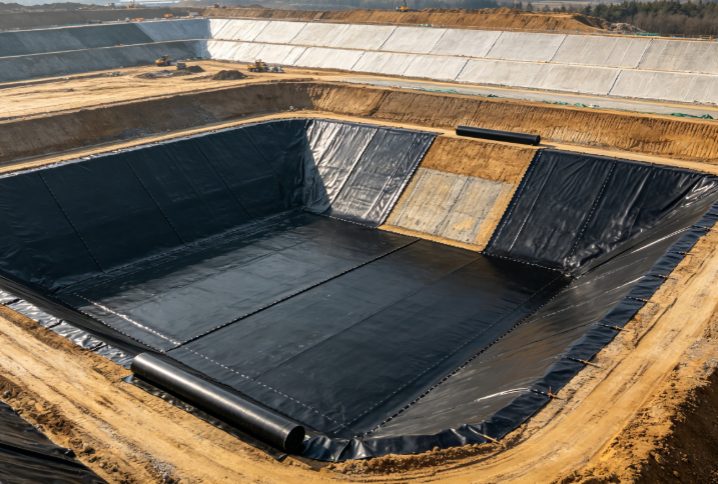
Table of Contents
1. Introduction
2. Core Functions of HDPE Geomembrane in Landfill Impermeability System
3. Standard Material Selection Rules for Landfill Impermeable Membrane
4. Standard Welding Construction Process for Geomembrane
5. Key Quality Control Standards for Geomembrane Welding
6. Performance Comparison of Common Landfill Impermeable Materials
7. Common Construction Defects and Improvement Measures
8. Summary
9. Industry FAQ
1. Introduction
Landfill pollution control is a core part of modern environmental protection engineering. Leachate and landfill gas leakage cause irreversible damage to soil and groundwater resources.
A stable landfill impermeability system is the key barrier to block pollutant diffusion. HDPE geomembrane is the most widely used core material for landfill anti-seepage projects worldwide.
Industry data shows the global market size of HDPE landfill liner reaches 1.8–2.3 billion USD in 2025. The market keeps a 7.2%–8.9% annual growth rate till 2034.
Its ultra-low permeability, long service life and stable chemical resistance make it replace traditional impermeable materials in most landfill projects.
2. Core Functions of HDPE Geomembrane in Landfill Impermeability System
A complete landfill impermeability system includes bottom liner, slope anti-seepage layer and top cover layer. All parts need reliable barrier materials.
HDPE geomembrane has a hydraulic conductivity lower than 10⁻¹¹ cm/s. It can resist long-term erosion of acidic, alkaline and organic leachate.
Buried and covered HDPE landfill impermeable membrane has a service life of 70–120 years. Exposed installation can still work stably for 25–50 years.
Most municipal and hazardous waste landfills adopt double-liner structure. HDPE geomembrane undertakes the main anti-seepage task of the whole system.
3. Standard Material Selection Rules for Landfill Impermeable Membrane
3.1 Thickness Selection by Landfill Type
Different landfill scenarios have fixed thickness standards for HDPE geomembrane. Wrong thickness selection leads to early aging and leakage risks.
Ordinary municipal solid waste landfills use 1.5 mm HDPE liner. This specification meets EPA Subtitle D and GRI-GM13 basic requirements.
Hazardous waste landfills need 2.0 mm HDPE geomembrane. It provides higher puncture resistance and chemical stability.
Deep landfills with waste height over 30 m adopt 2.5 mm thick membrane. It avoids membrane tearing under high pressure and slope tension.
3.2 Core Performance Index Requirements
Qualified landfill HDPE geomembrane must pass GRI-GM13 and ASTM standard tests. Core indexes decide long-term operation safety.
The minimum oxidative induction time (OIT) is 100 minutes. Long-life projects require OIT over 150 minutes to ensure anti-oxidation ability.
Material density is not less than 0.940 g/cm³. Tensile strength reaches 27 MPa or above to resist construction damage.
4. Standard Welding Construction Process for Geomembrane
Geomembrane welding is the weakest link of landfill anti-seepage construction. More than 80% of landfill leakage comes from unqualified welding joints.
Welding work can only proceed in dry and dust-free conditions. Windy, rainy and snowy weather stops all welding operations.
4.1 Pre-Welding Preparation
Clean all dust, water and mud on the overlapping area of two geomembranes before welding.
Control the overlapping width at 80–100 mm. Trim uneven membrane edges to ensure tight fitting.
4.2 Formal Welding Operation
Double-track hot wedge welding is the mainstream construction method for HDPE geomembrane.
Adjust welding temperature between 320℃ and 380℃ according to ambient temperature.
Keep welding speed at 2–4 meters per minute. Too fast causes virtual welding, too slow burns the membrane surface.
5. Key Quality Control Standards for Geomembrane Welding
5.1 On-Site Sampling Test
Take tensile test samples every 200 meters of welding seams.
Qualified weld strength must reach over 90% of the base membrane strength. Rework all sections with unqualified test results.
5.2 Vacuum Leak Detection
All double-track welding seams need full vacuum inspection.
Maintain 0.05 MPa vacuum pressure for 30 seconds. No pressure drop means the seam is completely sealed.
6. Performance Comparison of Common Landfill Impermeable Materials
Different impermeable materials show obvious differences in service life and engineering performance. The table below provides intuitive data reference.
Material Type | Common Thickness | Buried Service Life | Leachate Resistance | Welding Stability |
HDPE Geomembrane | 1.5–2.0 mm | 70–120 years | Excellent | Stable |
LLDPE Geomembrane | 1.5–2.0 mm | 50–80 years | Good | Medium |
PVC Geomembrane | 2.0–3.0 mm | 20–50 years | General | Poor |
7. Common Construction Defects and Improvement Measures
Weld bubbling is the most common defect. It is caused by residual water and impurities on membrane surface.
Cut off all bubbling sections completely. Clean the joint area and re-weld to ensure tight sealing.
Corner positions often have insufficient weld width. Strengthen manual inspection for all corner welding seams.
8. Summary
HDPE geomembrane is the core material of modern landfill impermeability system. Scientific material selection guarantees long-term anti-seepage effect.
Standard geomembrane welding and strict quality control eliminate most leakage risks of landfill impermeable membrane.
With stricter global environmental standards, HDPE anti-seepage solutions will keep dominating landfill engineering markets.
9. Industry FAQ
Q1: Why HDPE geomembrane is the top choice for landfill anti-seepage?
A1: HDPE material has ultra-low permeability and strong chemical resistance. It has much longer service life than LLDPE and PVC materials. Its stable welding performance fits large-scale landfill construction.
Q2: What is the main failure point of landfill impermeability system?
A2: Geomembrane welding joints are the weakest part. Unclean surface, unstable temperature and irregular operation all cause hidden leakage risks.
Q3: Is 1.5 mm HDPE liner suitable for municipal landfills?
A3: Yes. It meets EPA Subtitle D and GRI-GM13 standards. For high-load and deep landfills, 2.0 mm or thicker membrane is better for higher safety.
Q4: How to judge welding quality quickly on site?
A4: Vacuum leak detection and tensile sampling test are two core methods. Stable vacuum pressure and over 90% weld strength mean qualified construction.
Related articles
May 17, 2026
Geogrid Material Selection Guide: Performance and Cost Comparison of Glass Fiber vs. Polyester vs. Steel-Plastic in Subgrade Reinforcement
May 16, 2026
Key design points of composite geomembranes in landfill anti-seepage systems: the entire process from HDPE membrane thickness to seam welding to leakage detection